
Shadow's Infernal Treasury — Deck Primer
If we’re going to run Shadow, we’re not doing it politely. We’re doing it the Rakdos hellspawn way: make shiny stuff, break shiny stuff, and put lethal on board while everyone else is still counting their sad little mana rocks.
This is Daemon Sparda territory. The tone is devilish, the lines are mean, and the deck is unapologetically nasty.
Why Shadow?
Let's talk about what this hedgehog actually does, because the card is doing a lot of dirty work.
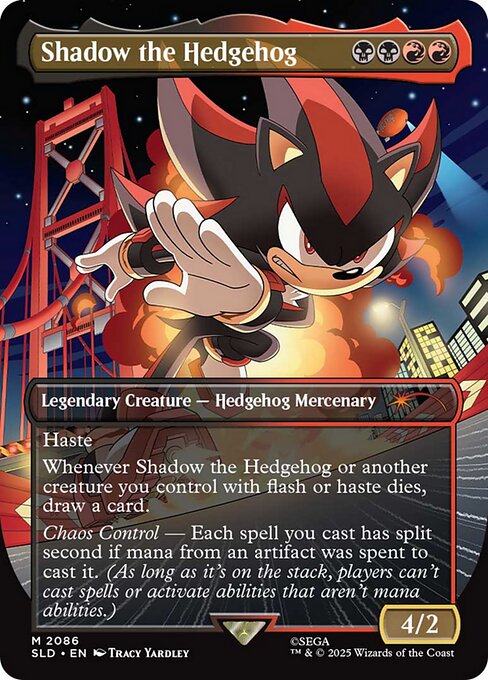
Shadow the Hedgehog is a 
 4/2 creature with Haste. Already fine. Then it gets weird:
Whenever Shadow the Hedgehog or another creature you control with flash or haste dies, draw a card.
Translation: every hasty or flash creature we throw into the void is a free card. Shadow wants us to run a sacrifice engine loaded with fast bodies — tokens, haste lords, anything that can hit and immediately become fuel. Sac outlets turn every disposable creature into card advantage, and we're in Rakdos, so we have an embarrassing number of ways to make that happen.
But the real reason we're here is Chaos Control:
Each spell you cast has split second if mana from an artifact was spent to cast it.
There it is. If we crack a Treasure to help pay for a spell, that spell gets split second. No responses. No counters. No panic activations. The table just watches it resolve and suffers.
This means Torment of Hailfire and Exsanguinate — our main finishers — become completely uncounterable the moment we crack one lousy Treasure to help cast them. We're already building a Treasure engine for mana. Now that same engine makes our kill spells immune to interaction. The two halves of this deck aren't just synergistic — they're the same damn plan.
We print Treasures. We flood the board with hasty creatures. We sac them for cards. We cash out with a split-second bomb that the table cannot answer. That's the whole game.
Hellforge Deck Preview
Shadow's Infernal Treasury
100 cardsRakdos Commander decklist
Shadow the Hedgehog
Deck Identity
This list runs on three overlapping plans that all feed each other:
- Treasure generation to accelerate and fix mana
- Aristocrats payoffs that punish sacrifice and death triggers
- Explosive finishers with burst mana
The important part: we don’t rely on one fragile combo line. If somebody nukes one engine, we keep moving and make a different infernal mess.
Core Engines
Treasure package
One-shot burst

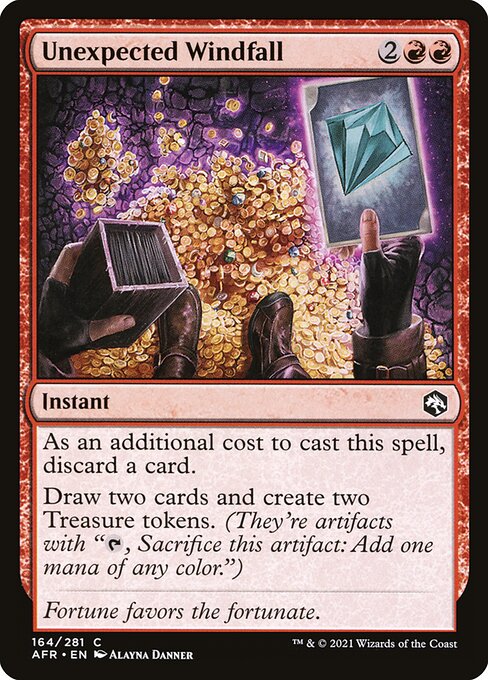
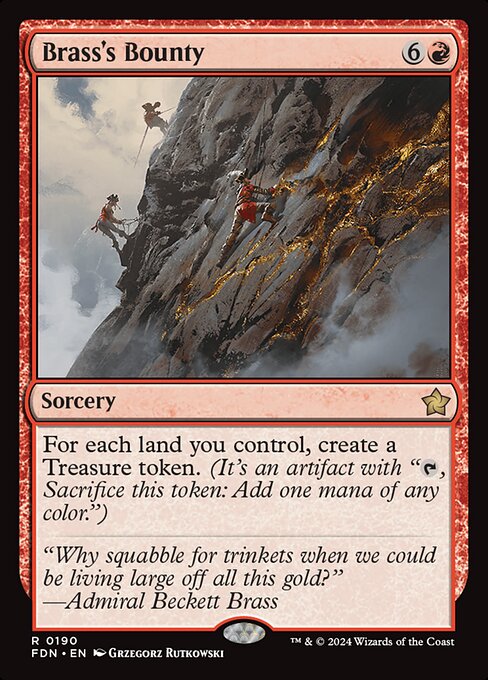


These are the single-fire spells we jam when we need a sudden flood of Treasures and cards in one shot. They don't stick around, but the burst they provide can flip the board state in an instant.
Big Score and Unexpected Windfall are the same deal from two different angles: discard a card, draw two, make two Treasures. Both are instants, which means we can hold them until end of turn, crack them in response to something, or use them as split-second setups. The Treasure count jumps by two and our hand quality improves in the same motion.
Brass's Bounty is the late-game nuke of the package. One Treasure per Mountain in play — and we run a lot of Mountains. Drop this when the board is stalled and suddenly we're sitting on a dozen Treasures heading into our next main phase. Combine it with Goldspan Dragon already in play and that pile taps for two each. The split-second finisher then becomes truly obscene.
Seize the Spoils is low-key great here. Three mana to draw two, discard one, and create a Treasure — the discard is not a drawback, it's synergy. We frequently want things in the graveyard for Underworld Breach, and the Treasure it makes immediately qualifies that next spell for split second.
Deadly Dispute is a two-mana instant that sacrifices a creature or artifact, draws two cards, and creates a Treasure. In a deck swimming in tokens and disposable bodies that's essentially "pay one mana: draw two and make a Treasure." It threatens to double-dip with every aristocrat on board thanks to the sacrifice trigger, and the Treasure it creates instantly enables split second on whatever we cast next.
Constant treasure generators
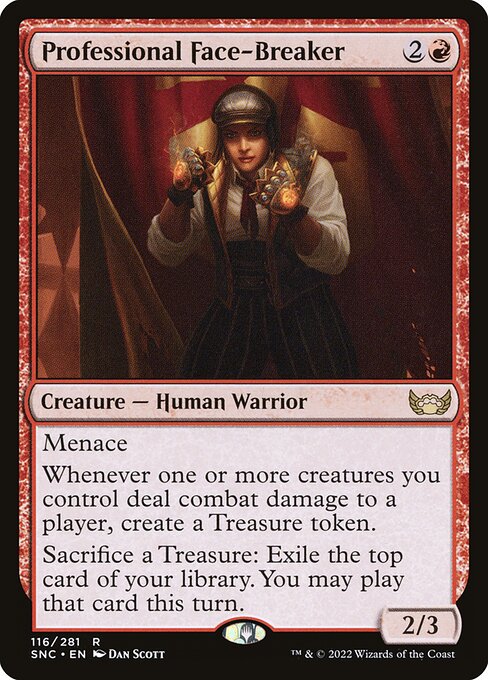
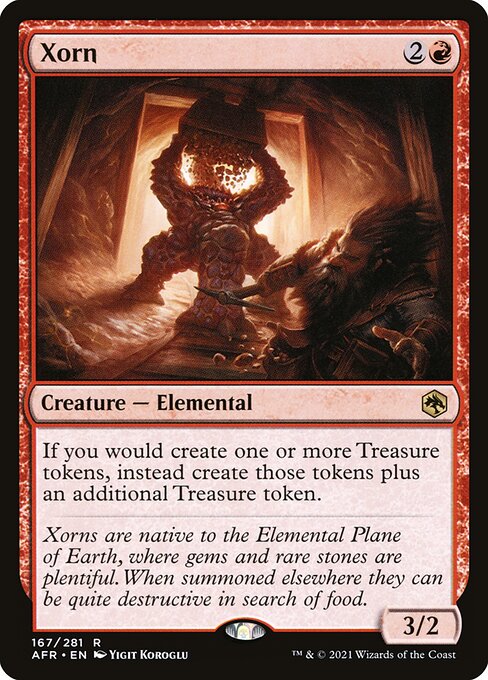
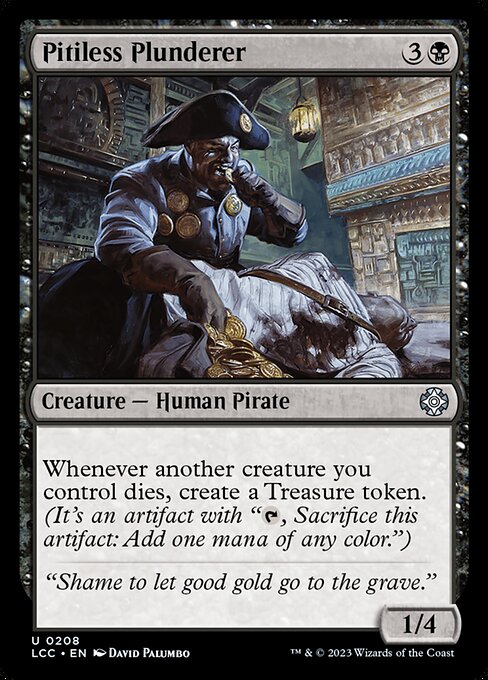


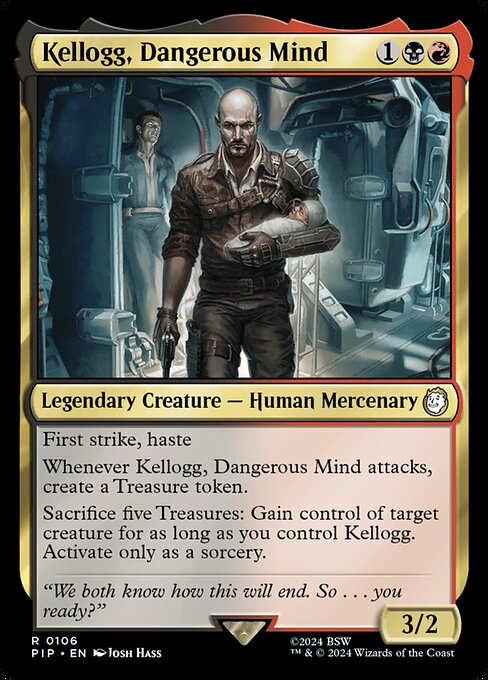
These are the cards that keep the Treasure engine churning every single turn rather than firing once and going quiet.
Professional Face-Breaker creates a Treasure every time you deal combat damage to a player. It also has a built-in mana sink: spend a Treasure to exile the top card of your library and play it that turn, which turns a pile of Treasures directly into action. It keeps delivering value as long as it's connecting, and in a deck that can give it haste support, that's often more than once.
Xorn is a multiplier engine. Whenever we create one or more Treasure tokens, Xorn adds an extra one. Every sac trigger, every spell, every attack step that prints a Treasure now prints two. Stack it with Academy Manufactor and things start getting genuinely obscene.
Pitiless Plunderer is the backbone. Every creature that dies — tokens, haste bodies, whatever we're throwing into the sac outlet — prints a Treasure. In a deck full of disposable creatures, that translates to a steady, often absurd flood of artifacts without us spending a single extra card.
Goldspan Dragon does two things: it creates a Treasure whenever it attacks or becomes the target of a spell, and it makes every Treasure we control tap for two mana of any one color instead of one. That second line is what makes it genuinely broken here. Our entire Treasure pile just doubled in output. Opponents targeting it with removal lets us get a free Treasure on the way out — and since it has haste it's attacking and creating the first Treasure the turn it lands.
Black Market Connections triggers at the beginning of our first main phase and lets us choose one or more options: create a Treasure for 1 life, draw a card for 2 life, or create a 3/2 Shapeshifter token for 3 life. We can take all three at once for 6 life if we want the full package. In a deck that ends games with large X spells, trading life for mana and cards every turn is almost always right, and the flexibility to mix and match based on what the game needs makes it quietly one of the best engines in the list.
Atsushi, the Blazing Sky is a 4/4 flying trampler that we're actively looking to sacrifice. When it dies we choose between three Treasure tokens or exiling the top two cards of our library to play until end of our next turn — and in this deck we almost always take the Treasures. Throw it into any free sac outlet, collect three Treasures, then use Underworld Breach or any recursion piece to do it again. The threat of it swinging in the air is just a bonus that keeps the table honest.
Kellogg, Dangerous Mind has haste and first strike baked in, so it's attacking and creating a Treasure the turn it lands. The secondary ability — sacrifice five Treasures to steal a creature — is a legitimate threat that forces the table to think twice about leaving anything too dangerous in play. In a deck that routinely floods out Treasures, five is not an unreasonable cost.
Sacrifice package

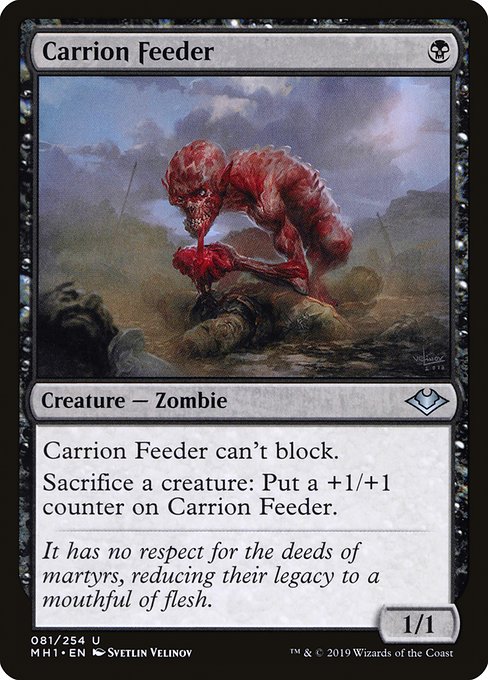
Cheap outlets are the grease in the machine. They let us cash in throwaway bodies and artifacts whenever it hurts opponents the fucking most.
Viscera Seer is a one-mana 1/1 that lets us sacrifice a creature to scry 1. Free to activate, instant speed, and gives us board control over what we draw next. In a deck that generates waves of tokens and throwaway bodies, having a free sac outlet that also filters draws is quietly one of the most valuable things we can have.
Carrion Feeder is a zero-mana 1/1 zombie that grows every time we feed it a creature. No activation cost, no restrictions. It eats our tokens and disposable bodies for free, triggers every death payoff on the board, and gets out of hand fast in a token-heavy turn.
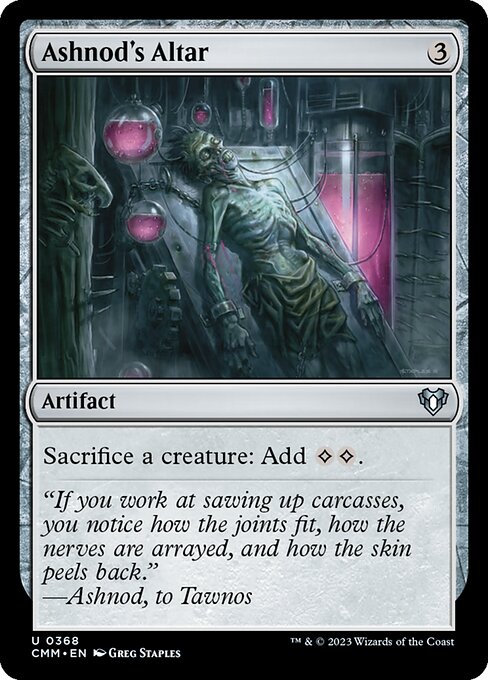
Ashnod's Altar converts any creature into two colorless mana. When we're flooding the board with tokens and hastey bodies, this turns every sac trigger into ramp. Pair it with Pitiless Plunderer and each creature death becomes two mana and a Treasure — fuel for the engine and for the finisher simultaneously.
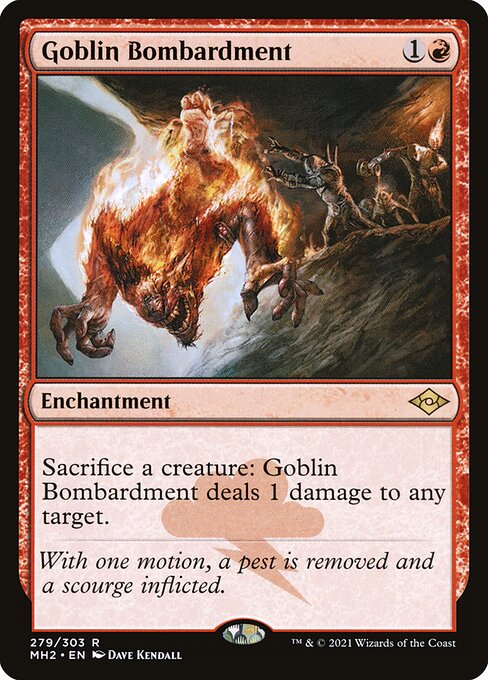
Goblin Bombardment is a free sac outlet that flings creatures at any target for one damage on death. It doesn't look like much per trigger, but in a deck that churns out tokens constantly, it adds up into meaningful chip and face damage. It also lets us choose when things die at instant speed, which matters when we need to dodge a removal spell or time a death trigger optimally.
Aristocrats payoff package
These are the cards that turn every death and every sacrifice into pain for the table. Each one converts our disposable tokens and Treasures into a countdown.
Blood Artist drains one life from a target player and gains us one whenever any creature dies — not just ours. Every token we sac, every sweep the table casts, every board wipe someone fires off feeds Blood Artist. In a game with four players and a lot of dying things, this quietly ticks everyone down to a dangerous number without drawing much attention until it's too late.
Zulaport Cutthroat is Blood Artist on legs with a slight restriction — it only triggers off our creatures dying, but the life loss is spread to all opponents at once. In a four-player game that means every death pings the whole table for one. Sac ten creatures in a turn and everyone takes ten damage simultaneously. Stacked with Blood Artist, the math gets ugly fast.
Nadier's Nightblade hits opponents for one life whenever a token we control leaves the battlefield — including tokens being sacrificed, not just dying to removal. Every Treasure we crack, every token we throw into a sac outlet, triggers it. In a Treasure-heavy turn where we're cracking a dozen artifacts to cast a finisher, this pings for twelve before the spell even resolves.
Marionette Master is the most explosive payoff in the package. Fabricate 3 means we either land with three +1/+1 counters — making it a 4/6 — or drop three Servo tokens onto the board instead. We almost always take the counters. From that point, whenever any artifact we control hits the graveyard from the battlefield, a target opponent loses life equal to its power. That's four life per Treasure cracked, pointed at one player. Crack ten Treasures in a single turn and someone eats forty damage before the finisher even resolves. The line is simple: flood Treasures, point Marionette at whoever is closest to death, and watch them evaporate.
Mayhem Devil pings any target for one damage whenever a player sacrifices a permanent. Any permanent — including our Treasures, our opponents' fetchlands, their own sac outlets. In Treasure-heavy turns it becomes a machine gun pointed at faces, planeswalkers, or utility creatures. It also keeps opponents honest about sacrificing their own things, which is a subtle but real form of board control.
Typical Game Flow
Opening hand
Keep: two or three lands, one ramp or Treasure piece, one payoff or sac outlet. Doesn't have to be perfect. One good piece is enough to find the rest.
Ship back: hands with no lands, hands with five or more lands and nothing else, hands that are all payoffs with no way to enable them. A hand of Blood Artist, Zulaport Cutthroat, Marionette Master, Mayhem Devil, and three lands is a trap — we'll sit there doing nothing for three turns while the table gets ahead.
Keep on six: if the six-card hand has a strong two-drop and a land, we're probably fine. This deck recovers well from slightly slow starts because one good Treasure burst or one good Pitiless Plunderer turn can catch us back up fast.
Cards that make borderline hands keepable: Curse of Opulence, Black Market Connections, Deadly Dispute, Dark Ritual. Any of these in a land-light hand means we have velocity and shouldn't panic.
Early game (turns 1–3)
The goal is to drop one anchor piece and establish that we're a threat worth respecting but not the first target. We don't want to play Shadow on turn four into nothing — we want a sac outlet or a payoff already in play so the first haste creature we sac immediately starts paying dividends.
Priority order for early plays:
- A free or cheap sac outlet — Viscera Seer, Carrion Feeder, Ashnod's Altar
- A Treasure generator that comes down early — Curse of Opulence, Black Market Connections, Pitiless Plunderer
- A death payoff to preload — Blood Artist, Mayhem Devil, Zulaport Cutthroat
Avoid overcommitting to the board early. We are not a fast aggro deck. We're setting up so the mid game hits hard. If we dump our hand turn two trying to go fast, we get wiped and start from zero.
Watch out for: opponents playing fast artifact hate (Collector Ouphe effects, Null Rod, Stony Silence), graveyard hate if we're leaning on Underworld Breach, and blue players holding up countermagic. If we see those, plan around using Shadow's split second to protect the important spells.
Mid game (turns 4–7)
This is where the deck gets mean. Shadow hits the table and suddenly every sac trigger is also a card draw. We want Pitiless Plunderer or Kellogg online here because the Treasure flood starts getting out of hand fast.
Focus on building a wide base rather than going all-in on one line. The best mid-game position is:
- Shadow in play with a sac outlet available
- One to two Treasure generators running
- One or two death payoffs on board
- A healthy grip of cards from combat and sac triggers
When the Treasure pile starts swelling, think about timing. Don't crack them all immediately. Always hold at least one back — when we're ready to cast a key spell, we crack it as part of the payment, the spell gets split second, and the table can do absolutely nothing about it.
Watch out for: board wipes (hold a chump attacker back to sac to Goblin Bombardment in response, or hold Deadly Dispute to cash a creature in before the wipe), targeted removal on Shadow (let non-haste creatures eat removal first), and anyone building a combo that hits faster than we do.
Late game (turns 8+)
The table should be scared of us by now. Every untapped Treasure is a potential split second spell. Every open mana is a threat. We want:
- Enough Treasures to cast a lethal Torment of Hailfire or Exsanguinate with at least one cracked for split second
- Marionette Master in play if we're going the artifact-drain route
- Revel in Riches as a backup win condition that taxes removal
The kill window usually opens after a big Treasure swing — Brass's Bounty off ten Mountains, a Pitiless Plunderer + sac loop, or a Goldspan Dragon turn where everything tapped for two. Once we hit that window, cast the finisher with all your Treasures and watch the table fold.
If we get wiped before we can close, take stock before panicking. Treasures are artifacts, not creatures — they survive every creature board wipe, and so does Black Market Connections if it's in play. We don't reset to zero; we reset to whatever artifacts and enchantments are still on the table.
Recovery priority after a wipe:
- Drop a sac outlet first. Even one — Viscera Seer, Carrion Feeder, Goblin Bombardment. Any creature that dies going forward needs to be captured, and we can't do that without somewhere to put them.
- Refill the hand. Seize the Spoils, Unexpected Windfall, or any draw piece gets grip back fast. If we're topdecking, we're just waiting to rip something good.
- Chain back with Underworld Breach. We naturally filled the graveyard all game. Breach lets us replay a Blood Artist, a Pitiless Plunderer, or a velocity spell for escape cost — which in a Treasure-heavy position is almost nothing.
The deck has more redundancy than it looks like. A single payoff creature landing into five Treasures still on board is all it takes to get back in the game.
Favorite Synergies in the List
These are the interactions that make the deck feel genuinely disgusting when they come together. None of them require the whole table to line up — just two pieces clicking at the right moment is usually enough.
Pitiless Plunderer + any free sac outlet: Every creature death becomes a Treasure. With Carrion Feeder or Viscera Seer on board, we're converting token after token into an artifact pile that grows faster than anyone expects. Add Shadow and every death also refills our hand.
Academy Manufactor + any Treasure creation: This card is the reason opponents should kill it immediately and often don't. One Treasure trigger becomes a Treasure, a Food, and a Clue. One Black Market Connections activation becomes three artifacts. One Brass's Bounty becomes three times the pile. The multiplier effect is absurd and compounds with every subsequent trigger.
Nadier's Nightblade + cracking Treasures for a finisher: We're already spending those Treasures to cast the kill spell. Every one we sacrifice pings an opponent for one before the spell even resolves. Ten Treasures into an Exsanguinate is ten damage plus the drain. They're often dead before the X resolves.
Mayhem Devil + treasure-heavy turns: Every Treasure we crack is a free ping to any target. In a turn where we're cracking eight Treasures to cast a Torment of Hailfire, Mayhem Devil has already done eight damage to faces or finished off a planeswalker before the spell lands. It also punishes opponents who sacrifice fetchlands, treasures of their own, or anything else — we get the trigger regardless of who's doing the sacrificing.
Marionette Master + Ashnod's Altar + tokens: When we take the counters from Fabricate, Marionette is a 4/6. Sacrifice any artifact creature to the Altar for two mana and Marionette drains for four. We made two mana and an opponent lost four life off one sac activation. Loop that with enough artifact creatures and someone just dies.
Goldspan Dragon + Brass's Bounty: Brass's Bounty off ten Mountains is already ten Treasures. With Goldspan Dragon in play, those ten Treasures tap for twenty mana. Cast a Torment of Hailfire for X equals eighteen. That's unanswerable and usually lethal.
Underworld Breach + the graveyard we naturally fill: We discard into the yard with Seize the Spoils and Unexpected Windfall all game. When Underworld Breach comes down, we can recast key velocity spells, replay a Blood Artist or Pitiless Plunderer, or retrieve a finisher we couldn't cast last turn. The escape cost is cheap in a deck that churns through cards constantly.
Why I Like This Deck
What makes Shadow different from other Rakdos artifact decks is the split second angle. Most treasure decks just make mana and then try to resolve something. Shadow makes mana and simultaneously makes that something uncounterable. The engine and the protection are the same resource. That's elegant in a way a lot of Commander decks aren't.
The games play differently depending on what the table does. Against a blue-heavy pod, we're political and patient — we let the control players tire each other out, build our engine quietly, then finish with a split-second bomb nobody can touch. Against aggressive pods, we're the payoff machine — our tokens and death triggers drain everyone down while we rebuild from every wipe. Against combo, we race and aim for the split-second finisher before they assemble.
None of those gameplans feel like the same deck from the outside, but they're all Shadow. That flexibility is why the deck rewards experience. The longer you play it, the better you get at reading which mode is correct for the table you're sitting at.
The deck is cruel on purpose and fun precisely because of it. There is something deeply satisfying about dropping a Torment of Hailfire for X equals fourteen, watching the whole table reach for their counters and realizing they don't get to use them.
Want the full damn list?
Open Card List